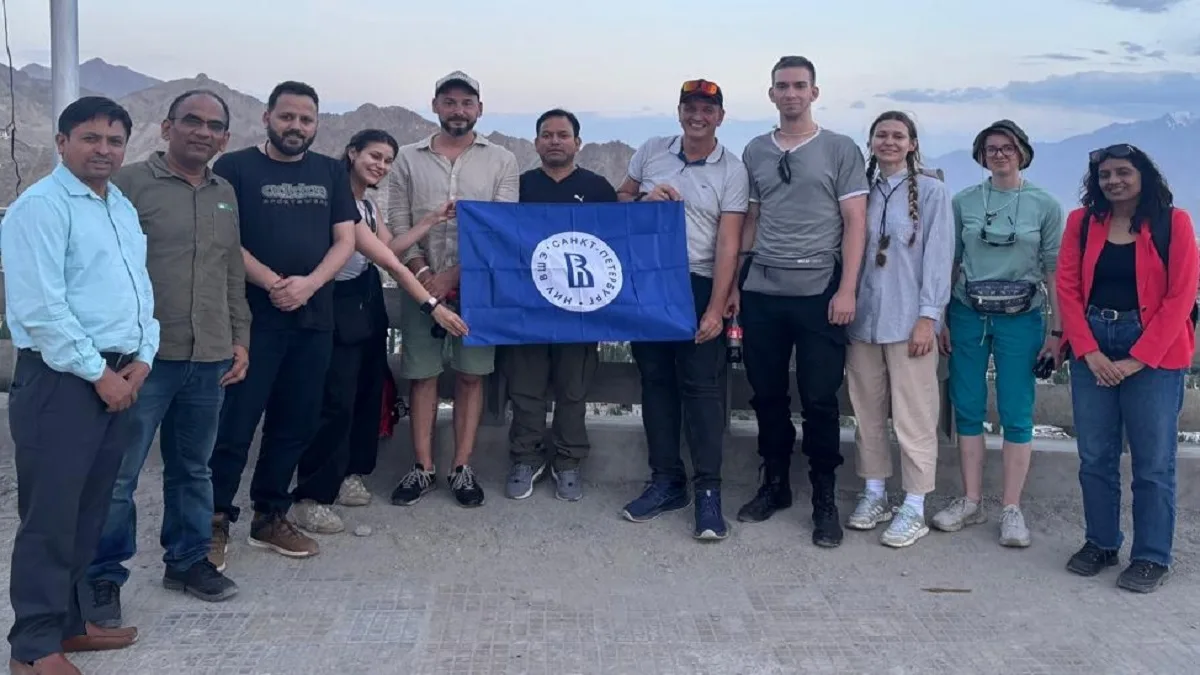
In a pioneering step to address the escalating climate crisis in the fragile Himalayan ecosystem, a host of institutes have come forward to launch the 3rd International Summer School and Expedition in the Western Himalayas.
The initiative was taken by the Department of Environmental Studies, PGDAV (M) College, University of Delhi, in collaboration with the Centre for Interdisciplinary Studies on Mountain and Hill Environment (CISMHE), University of Delhi, and the Department of Earth Sciences, Institute of Mountain Environment, Bhaderwah Campus, University of Jammu.
Advertisement
Being held from July 5 to 15 in Ladakh, the academic field initiative focuses on the theme “Confronting the Climate Challenge in the Indian Himalayas: Pathways to Resilience.”
The event has brought together leading environmental scientists, researchers, and policy experts from India and Russia—including a delegation from HSE University, Saint Petersburg—to develop community-led models of climate resilience in one of the world’s most ecologically sensitive zones.
Key issues under study include rising temperatures, accelerated glacial melt, erratic precipitation patterns, water scarcity, and the increasing frequency of extreme weather events. Participants are engaging directly with local communities to assess ground realities and explore sustainable solutions.
Prof. Rahul Gupta, Rector of Bhaderwah Campus, lauded the initiative and called for stronger research-driven policymaking in mountainous regions like Ladakh. “Collaborative outreach like this is vital to inform governance frameworks and develop adaptive responses in ecologically fragile areas,” he said.
Prof. Darvinder Kumar, Principal of PGDAV College, has guided the research design of the workshop, stressing the importance of grassroots data and statistical rigor to ensure academic and practical impact.
Prof. Vandana Mishra, Director of CISMHE, highlighted three key outcomes of the Indo-Russian partnership: Field-based insights into resilience, sustainable farming, and traditional governance, Data-driven strategies for climate adaptation, biodiversity conservation, and water resource management and Strengthened academic ties between India and Russia through student exchange, joint research, and collaborative funding.
Prof. Alexander, Dean of the School of Social Sciences, HSE University, stressed the value of integrating traditional ecological knowledge with scientific research to build sustainable policies tailored to climate-vulnerable regions like Ladakh.
Dr. Pardeep Singh, Convener of the workshop, emphasized the role of cross-disciplinary collaboration and indigenous wisdom in building resilient mountain communities. Organizing Secretary Dr. Chhering Tandup noted that conducting such events on-site ensures that climate discourse is grounded in the lived experiences of Ladakh’s people.
Dr. Richa Agarwal Malik shared that the expedition is conducting field-level investigations on community awareness, coping strategies, local solutions, and expectations from governance. She underscored the urgency of crafting adaptation strategies that are both ecologically sound and economically feasible.
Among other notable contributors are Dr. Chander Pal Singh, Dr. Chhetan Chhoidub, and Dr. Dimitri Omelchenko, who brings diverse expertise to this critical mission.
The Summer School marks a significant step in fostering global-local collaboration and building sustainable, community-driven pathways to resilience in the Indian Himalayas—offering a replicable model for climate adaptation in high-altitude regions across the globe.